
DAR Distributes 156 Land Titles in Palawan
What Property Buyers Should Understand About Agrarian-Reform Land
Land ownership became more secure for another group of Palawan farmers this month.
The Philippine Information Agency reported on September 21 that DAR-Palawan distributed 156 land titles covering 214.4548 hectares to 145 agrarian reform beneficiaries. The distribution itself took place September 14.
The beneficiaries come from six municipalities across the province.
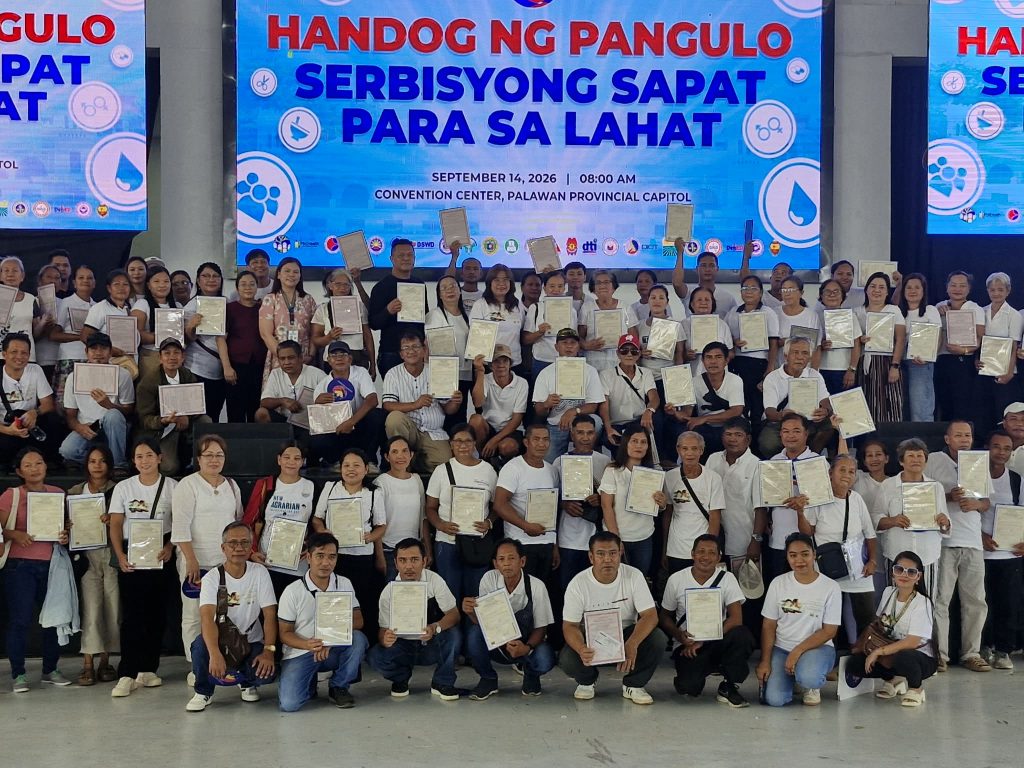
Narra had 47 beneficiaries receiving 46 titles covering 61.2081 hectares. Quezon had 33 beneficiaries and 41 titles covering 58.1153 hectares. Roxas had 27 beneficiaries and 39 titles over 36.9651 hectares.
The remaining titles were distributed in Sofronio Española, Taytay and Aborlan.
For the beneficiaries, the importance is straightforward: documentation provides stronger security over their agricultural holdings.
For the wider Palawan property market, however, the development is also an opportunity to clarify something buyers frequently misunderstand.
A title establishes important rights—but does not answer every property question
Buyers sometimes reduce property verification to one question:
“May title ba?”
It is an essential question, but it should be the beginning of due diligence rather than its conclusion.
A title identifies registered ownership and contains important information about the property. It can also contain annotations affecting the owner’s rights.
But the existence of a title does not automatically establish that a property can be transferred without restriction or developed for whatever purpose a buyer intends.
That distinction is especially important with agricultural and agrarian-reform properties.
Agrarian-reform property deserves additional scrutiny
Properties awarded through agrarian-reform programs operate within a specific legal framework.
Depending on the property’s circumstances, restrictions may affect transfer, ownership, consolidation, conversion or other transactions.
Consequently, someone considering the purchase of agricultural land should not assume that a clean-looking physical title means an ordinary sale can proceed immediately.
The property’s history matters.
The legal basis under which the title was issued matters.
Its annotations matter.
And the proposed transaction matters.
Qualified legal and technical professionals should be involved when the circumstances require them.
Land use is a separate question
There is another common misunderstanding:
Owning land does not automatically authorize every possible use of that land.
A buyer might envision a resort, subdivision, commercial establishment or residential development.
Whether that vision is legally possible depends on factors beyond ownership.
Relevant questions can include the property’s land classification, zoning, agricultural status, environmental restrictions, applicable conversion requirements and local development controls.
This is particularly important in Palawan because development must also be considered within the province’s distinctive environmental and land-management framework.
Pilapil Properties analysis: documentation reduces uncertainty
From a real-estate-market perspective, systematic titling is valuable because uncertainty over ownership can make land difficult to finance, inherit, manage or transact.
But formalizing ownership should not be confused with immediately turning agricultural holdings into conventional market inventory.
The significance of the latest distribution is primarily tenure security for the beneficiaries.
Any future transaction involving an awarded property must still comply with the laws and restrictions applicable to that particular land.
A practical checklist for buyers
Before purchasing agricultural property in Palawan, a buyer should establish at minimum:
Who is the registered owner?
Is the title authentic and current?
Are there mortgages, adverse claims, restrictions or other annotations?
Does the seller have legal authority to transfer the property?
Was the land awarded through agrarian reform?
Are transfer restrictions still applicable?
What is the property’s legal land classification?
What does the applicable zoning allow?
Does the intended development require land-use conversion?
Does the surveyed property correspond to the land physically being shown?
Does it have legitimate legal access?
Are environmental or protected-area restrictions relevant?
The answers should come from authoritative records—not merely representations made by a seller or broker.
Conclusion
DAR-Palawan’s distribution of 156 titles is meaningful primarily because 145 Palawan farmers now have stronger documentation of their rights over more than 214 hectares of agricultural land.
For the wider public, it also illustrates an important property principle.
A land title is critically important.
But responsible property due diligence asks a second question after confirming ownership:
What rights, restrictions and legally permissible uses actually come with that land?
In Palawan real estate, that distinction can be crucial.